
Questions we get asked all the time, and their answers.
Parts compatibility, lead times, service scopes, new tower bids, and more. Answered by the people who build and repair the towers.
Which is better: crossflow or counterflow cooling towers?
Both crossflow and counterflow cooling towers offer distinct advantages, and the best choice depends on your application’s operating conditions and project requirements. Traditionally, industrial applications with poor water quality have favored crossflow cooling towers because they commonly utilize splash fill media, which is more tolerant of fouling. However, counterflow cooling towers can also be designed with splash fill media, providing many of the same water quality benefits while offering additional advantages.
Is there a limit to the size of cooling tower Cooling Tower Depot can manufacture?
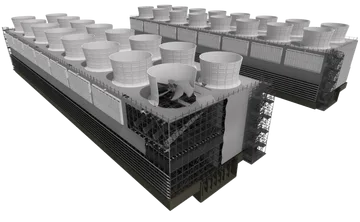
CTD specializes in large, field-erected cooling towers. Our projects typically begin at approximately 3,000 gallons per minute (GPM) and scale to 500,000 GPM and beyond.
What is an FM 4930-Approved Cooling Tower?
An FM-approved cooling tower has been tested and certified by FM Approvals, an independent testing and certification organization, to meet specific requirements for fire resistance, natural hazards testing, seismic analysis, and loss prevention. FM Approval is particularly important in industrial and commercial facilities where fire or natural disaster risk is a major concern, such as power plants, chemical plants, hospitals, universities, manufacturing facilities, and large commercial buildings. Additionally, operations looking to avoid the added cost and complexity of dedicated fire protection systems, FM-approved towers offer a proven alternative.
Why choose an FRP cooling tower over a traditional wood cooling tower?
FRP (fiberglass-reinforced plastic) cooling towers offer significant advantages in durability, corrosion resistance, maintenance, and service life. Unlike wood, FRP does not rot, decay, or absorb water. It is also highly resistant to many chemicals and harsh industrial environments. For facilities looking for a long-term cooling solution with reduced maintenance requirements, FRP construction can provide a lower total cost of ownership over the life of the tower.
How can I get colder water or more capacity out of my cooling tower?
There are several ways to improve cooling tower performance, depending on the source of the limitation. Potential solutions include: Increasing airflow through the tower; Optimizing fan pitch and operating speed; Improving water distribution; Replacing damaged, fouled, or deteriorated fill; Cleaning or replacing clogged nozzles; Correcting excessive drift or air bypass; Improving fan tip clearances; Adding or upgrading cooling tower cells
What is driving demand for new cooling towers?
Growth in power generation, data centers, manufacturing, and refining is increasing demand for reliable, high-capacity cooling systems. Aging infrastructure and plant expansions are also driving new tower construction and replacement projects.
What cooling tower applications does Cooling Tower Depot support in the data center and HVAC markets?
CTD can provide cooling solutions, including FM Approved 4930 towers for data centers, hospitals, commercial buildings, campuses, and other mission-critical facilities. These applications often prioritize energy efficiency, redundancy, low maintenance, noise control, water conservation, and year-round reliability.
What are the latest trends in the cooling tower industry?
The cooling tower industry is increasingly focused on energy efficiency, water conservation, equipment reliability, improved materials, and smarter monitoring and controls. New designs and technologies are helping facilities reduce operating costs while maintaining cooling performance.
What cooling tower technologies are gaining popularity?
High-efficiency fill, fiberglass and pultruded structural components, variable-frequency drives, plume-abatement systems, and FM-approved towers are among the technologies gaining adoption across the industry.
How is the cooling tower industry addressing aging infrastructure?
Facilities are increasingly extending the life of existing towers through major rebuilds, thermal upgrades, component replacement, add-cell projects, and conversions to newer materials such as fiberglass. These solutions can improve performance without requiring a completely new tower.
Do you sell OEM cooling tower parts?
Yes. We frequently provide OEM parts, as well as high-quality aftermarket and replacement components when appropriate. CTD is also an authorized reseller for Marley components. Our goal is to provide the right part for the application, balancing compatibility, performance, availability, and total cost.
Do you stock cooling tower parts, or are they made to order?
Both. Many common cooling tower components are available from inventory or through established manufacturing partners, while larger or highly specialized components may be manufactured or engineered specifically for your order. Lead times vary depending on the type and quantity of parts required. Common replacement parts may be available quickly, while specialized components such as gearboxes, fan assemblies, or large quantities of fill media require additional manufacturing time. If your tower is down or you have an emergency, let our team know. We can help identify the fastest available solution.
Can Cooling Tower Depot provide emergency cooling tower parts?
Yes. We understand that cooling tower failures can result in significant production losses and unplanned downtime. Our team can assist with identifying critical replacement components and developing an expedited parts solution when possible.
Can you help me identify a cooling tower part?
Absolutely. If you don't know the exact part number, our team can often identify the component using photographs, equipment information, dimensions, manufacturer information, drawings, or existing part numbers.
Can you provide replacement parts for older cooling towers?
Yes. Cooling Tower Depot specializes in supporting aging cooling tower equipment and can help identify replacement components for towers that have been in service for decades. Even when an original component is obsolete or no longer available, we can often provide an engineered replacement or identify a compatible alternative.
How long has Cooling Tower Depot been in business?
Founded in 2003, CTD brought together industry leaders with more than 500 years of combined cooling tower experience. Their expertise laid the foundation for one of the industry’s most comprehensive cooling tower organizations. From the ground up, we built CTD with the future in mind—combining deep industry knowledge, engineering expertise, and a commitment to delivering better cooling tower solutions.
What industries does Cooling Tower Depot serve?
We serve a wide range of industries, including power generation, oil and gas, refining, steel, ethanol, manufacturing, food and beverage, and commercial HVAC.
Where does Cooling Tower Depot operate?
CTD supports cooling tower projects throughout North America and internationally, combining broad industry experience with local field service and project support.
Can Cooling Tower Depot design a new cooling tower?
Yes. Our engineering team designs cooling towers for specific site conditions, thermal requirements, water flow rates, and application needs. Our online Tower Designer can also generate a priced proposal, datasheets, and a general arrangement drawing.
Where is Cooling Tower Depot’s headquarters?
Our corporate headquarters is in Golden, Colorado. We have 7 other offices nationwide, including a Canada office and our fiberglass fabrication shop in Oklahoma.